

Uploading Images
Members of the Department can attach an image to a publication by logging in to the site and then clicking the edit link next to the publication titles below. Please note: all images attached to a publication will be visible on Department websites (including some research group sites, and the Department website)
Effect of additives on the stability of lithium-metal electrodes
Reassessing Methanesulfonic Acid as a Sea Ice Proxy: An Example From the Weddell Sea Sector
(doi: 10.1029/2026gl124543)
The AML-Associated A338V Mutation Rewires GPR183 Signaling through C‑Terminal Ensemble Redistribution
(doi: 10.1021/jacs.6c10287)
How Good Is DFT for Solid-Liquid Interfaces? A Comparison With the Random-Phase Approximation for Water on Graphene
WNT/β-catenin increases 3D chromatin mobility and reorganisation during posterior cell state transitions
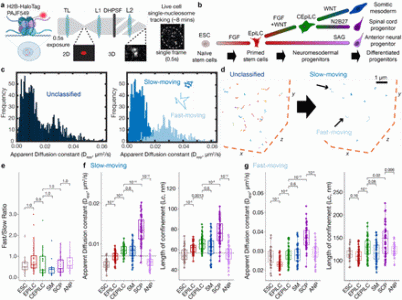
(doi: 10.64898/2026.10.05.756771)
RNA Synthesis and Degradation Regulate Biomolecular Condensates through Nonequilibrium Feedback
(doi: 10.1021/acscentsci.6c00933)
Nucleus-Independent Chemical Shifts in disordered nanoporous carbons are governed by the long-range magnetic response of the carbon framework
Near-atomistic simulations reveal the molecular principles that control chromatin structure and phase separation
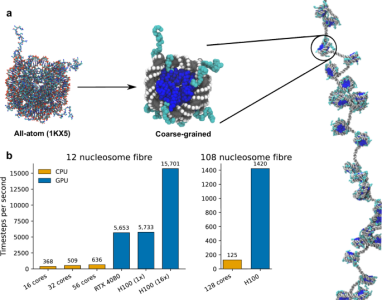
(doi: 10.1038/s41467-026-78050-6)
Ring Currents in Open-Shell Condensed Benzenoid Homologues of Some Extended Clar’s Goblets
(doi: 10.1021/acs.jpca.6c04818)
Long-Range Electrostatic Interactions with Remote Charges Modulate Cation–π Interaction Energies in Water
Binding without Docking: Small-Molecule Binding Paths on Disordered Proteins
(doi: 10.1021/jacs.6c05891)
One‐Pot Biphasic Photocatalytic CO
<sub>2</sub>
‐to‐Carbonylation Cascades
<sub>2</sub>
‐to‐Carbonylation Cascades
(doi: 10.1002/ange.5220236)
Assessing the Transferability of General-Purpose MachineLearning Interatomic Potentials for Heterogeneous Catalysis with HetCat26
- Page 1
